
Impact Market Update

Markets do not like uncertainty. After the United States and Israel launched an offensive against Iran, market volatility has increased sharply.
Oil prices spiked higher because Iran has the ability to disrupt shipping around the Strait of Hormuz, which could block oil tankers from passing through one of the world’s most important energy routes. International markets were hit especially hard because many countries in Asia and Europe rely more heavily on oil shipped through the Gulf than the United States
We also saw the Volatility Index rise sharply, while a flight to safety into U.S. dollars pushed the dollar higher.
Profit Taking
This was a sharp reversal from a trend that began last year, when international markets started outperforming domestic stocks. Last year the developed international index returned more than 31 percent, while the S&P 500 gained about 17 percent. Emerging markets did even better by gaining 33 percent for the year.
Part of the recent volatility in international markets is related to proximity to the conflict, but some of it also appears to be profit taking. International markets had been significantly outperforming U.S. markets this year. That is still true even with the recent pullback. As of this writing, international markets are still ahead of the S&P 500, which is now negative for the year.
When investors decide to reduce risk after a large run up, they often sell the areas that have appreciated the most in order to rebalance. Currency movements also play a major role. When the U.S. dollar strengthens, it tends to reduce the value of international assets priced in other currencies.
So what happens next?
Data from July 1926 – December 2025. Source: Ken French Data Library. Returns greater than one year are annualized. Past performance is no guarantee of future results.
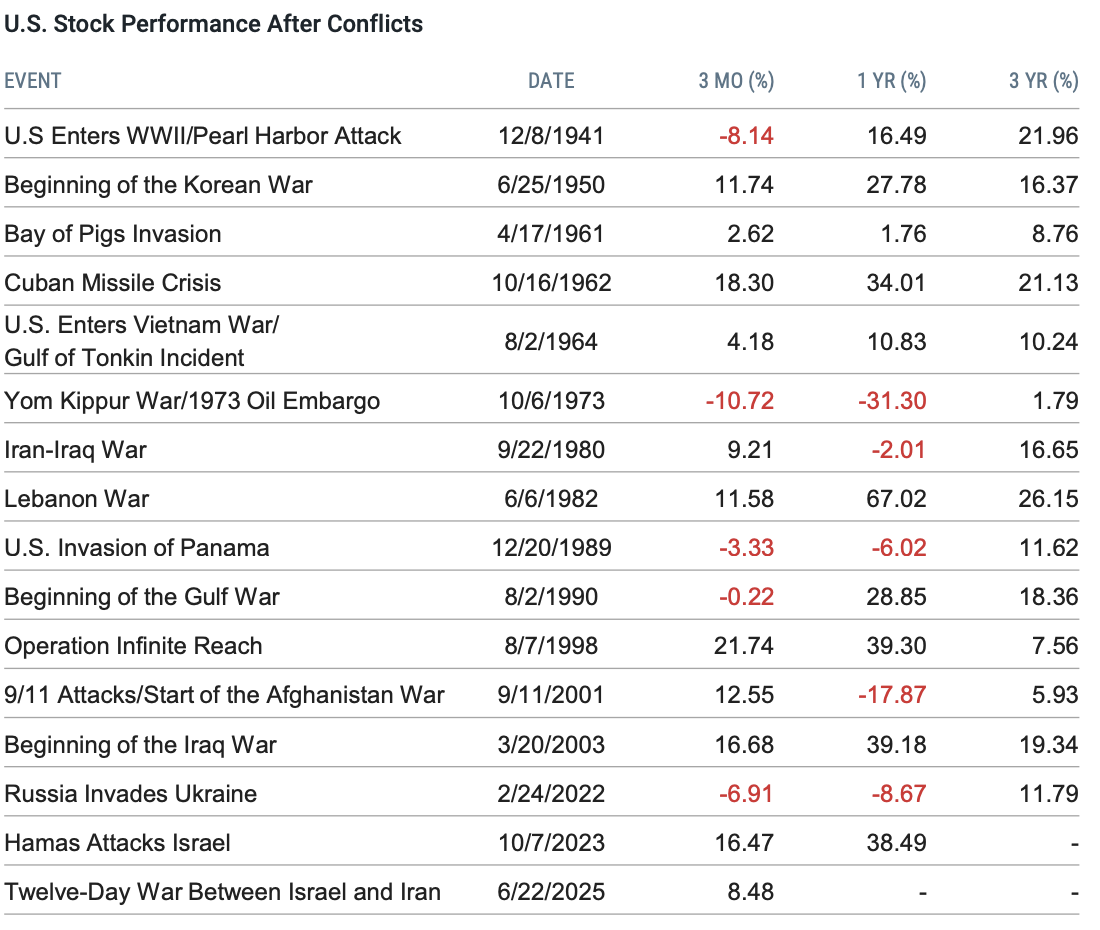
The good news is that these spikes in volatility around geopolitical events have historically been short lived. If you look at market reactions to major conflicts going back to the bombing of Pearl Harbor, markets have often recovered quickly.
In most cases stocks were higher about three months later. The takeaway is that if markets do decline, it is often for reasons unrelated to the initial geopolitical conflict or war.
Oil and Defense
Oil and defense companies often benefit during times of war as energy prices rise and military spending increases. Impact Fiduciary’s sustainable portfolios don’t have exposure to these companies in our portfolios.
I suspect the recent run up in oil prices will be short lived, and I remain hopeful that peace prevails sooner rather than later. Still, it is worth acknowledging the perverse incentives that exist in these industries.
Defense spending itself is necessary, and I am grateful for the U.S. military. However, is it really necessary for these defense companies to be publicly traded?
The companies have massive lobbying power that results in corporate capture. They really embody the worst aspects of a for profit enterprise trying to maximize shareholder value and outperform every quarter while leaching onto the US taxpayer. President Dwight Eisenhower warned about this dynamic decades ago when he cautioned against the growing influence of the military industrial complex.
The SAASpocalypse
Of course it is never a dull moment. Prior to the war with Iran, the headlines were focused on artificial intelligence massively disrupting the software industry or SAAS companies (software as a service).

The argument is that if AI becomes powerful enough, companies might simply build their own internal software rather than paying hundreds of thousands or even millions of dollars for enterprise software solutions.
A couple of viral blog posts have also suggested that artificial intelligence could cause unemployment to spike among professional jobs in the coming years, potentially leading to a vicious cycle of reduced consumer spending and slower economic growth.
My view is that much of this discussion is premature. No one really knows how this will all play out. If history is any guide, however, technological change tends to unfold gradually. Even when a powerful technology becomes available, it often takes years before it is widely adopted across industries.
The best personal hedge against uncertainty is still the same approach that has always worked. Live within your means while saving and investing consistently for the future. If artificial intelligence develops as quickly as some people expect, the productivity gains could ultimately be very positive for markets.
At Impact Fiduciary we invest primarily through ETFs that provide broad diversification across global markets. Our focus on sustainability allows us to avoid industries that we believe are remnants of the twentieth century and ripe for disruption while investing in companies that are positioned for the future.
Buy the Haystack
When it comes to investing, there will always be winners and losers. Instead of trying to find the single needle in the haystack, we believe it is more effective to buy the entire haystack.
Our sustainable index funds provide exposure to roughly two thousand companies around the world. We cannot predict the next NVIDIA or Apple, but there is a good chance the next breakthrough company is already in the portfolio.
This diversification also helps during periods of disruption. For example, the technology software index recently fell more than 30 percent in just a few months due to fears around AI. At the same time other sectors of the market began outperforming as capital rotated elsewhere.
This is one reason why chasing whatever has worked most recently can backfire. If an investor simply bought the best performing sector over the past few years, they would likely have ended up with a very concentrated position in tech companies.
The same lesson applies to company stock. We regularly work with clients who have accumulated large positions in their employer’s stock. Even companies that appear nearly invincible can decline dramatically. We’ve just seen recent examples of “bulletproof” companies that have lost more than half their value in a relatively short period of time.
Lots of Moving Parts
Moments like this are a good reminder of how many variables markets are constantly processing at once. In just the past few weeks we have seen a new geopolitical conflict, fears about AI disrupting entire industries, and large rotations between sectors of the market.
None of these developments were widely predicted a year ago, and it is a good illustration of why trying to forecast short term market movements is so difficult. The future rarely unfolds the way the headlines suggest it will.
What we do know is that innovation continues, companies adapt, and markets tend to reward long term progress over time. The biggest winners of the next decade may be companies that don’t even exist today. The same was true ten years ago.
There will always be periods of volatility, whether caused by war, technological disruption, or economic cycles. But history has consistently shown that disciplined investors who stay diversified and focused on the long term tend to be rewarded. Of course, you don’t need to navigate this alone. We are here for you.
Looking to go deeper or take the next step? Here are a few ways to continue the conversation: Explore More Insights or Schedule a Complimentary Discovery Call.
Disclaimer: This article is provided for general information and illustration purposes only. Nothing contained in the material constitutes tax advice, a recommendation for purchase or sale of any security, or investment advisory services. I encourage you to consult a financial planner, accountant, and/or legal counsel for advice specific to your situation. Reproduction of this material is prohibited without written permission from Patrick Dinan, and all rights are reserved.